FEATURED
CPJ Hails South Africa’s Abolition Of Criminal Defamation, Calls For Further Legal Reforms

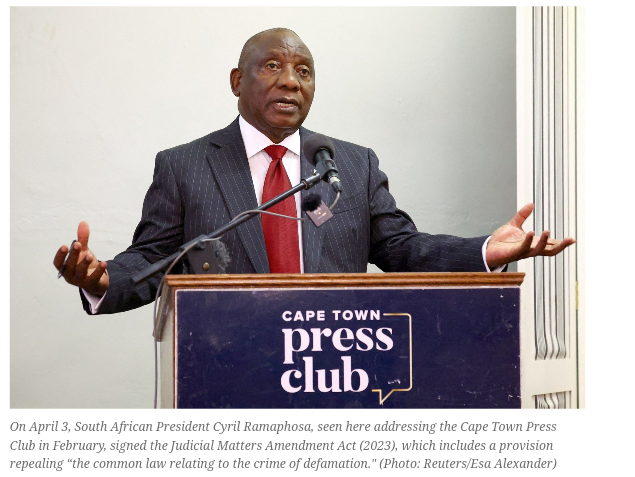
The Committee to Protect Journalists on Wednesday welcomed South African President Cyril Ramaphosa’s signing into law a bill that abolishes criminal defamation, and urged authorities to reform other problematic laws that threaten press freedom in the country.
On April 3, Ramaphosa signed the Judicial Matters Amendment Act (2023), which includes a provision repealing “the common law relating to the crime of defamation,” according to news reports and a statement by the president’s office. The South African parliament forwarded the bill to Ramaphosa for signature after approving it in December last year.
South Africa becomes the latest country in southern Africa to decriminalize defamation, following its neighbors Zimbabwe (2016) and Lesotho (2018). Other countries in the Southern Africa Development Community regional bloc which continue to use criminal defamation against journalists include Angola and the Democratic Republic of the Congo, according to CPJ research.
“The long-awaited repeal of the crime of defamation in South Africa is an important victory for press freedom and hopefully will reverberate positively across other parts of the region, such as Angola and the Democratic Republic of the Congo, where defamation continues to be used to criminalize journalism,” said Angela Quintal, head of CPJ’s Africa program, in New York. “South African authorities should also move swiftly to reform other laws, as well as draft legislation that threaten, or have the potential to undermine media freedom and the public’s right to information.”
South Africa’s parliament voted to abolish the common law crime of defamation, which is based on Roman Dutch Law and court precedents, on December 6, 2023 after decades of advocacy by the press, media lawyers, and civil society activists who argued that there were other remedies that did not involve prosecution or jail, such as civil defamation lawsuits for aggrieved parties who believed their reputations were impugned.
The 2013 conviction of newspaper journalist Cecil Motsepe was the most recent case in which a South African journalist was found guilty of criminal defamation, according to a guide on South African media law by the Thomson Reuters Foundation, a philanthropic body that works to advance press freedom. The conviction was overturned on appeal in 2014, although the court ruled that criminal defamation remained constitutional. CPJ was among a group of organizations that filed an amicus brief in support of Motsepe, arguing for the decriminalization of defamation in South Africa.
Despite the repeal of criminal defamation, several problematic laws remain, including the Cybercrimes Act, according to press freedom advocates. In a 2022 Universal Periodic Review submission, CPJ and four other partner organizations urged South African authorities to amend the Cybercrimes Act, which lacks public interest overrides for journalists and could affect the ability to publish leaked information. The organizations also called for reform of the Protected Disclosures Act in order to strengthen protection for whistleblowers and the Prevention and Combating of Hate Crimes and Hate Speech Bill, which criminalizes speech on broad terms and which commentators fear could undermine public debate. That bill is pending presidential approval.

Justice Deputy Minister John Jeffery told CPJ by phone that the lack of a public interest override was not raised during public submissions about the proposed Cybercrimes Act. The justice department was not averse to making changes to draft laws if threats to press freedom arose, and it had done so previously, even when journalists had raised concerns at the eleventh hour.
Civil society groups also raised concerns about the General Intelligence Laws Amendment Bill currently before Parliament arguing in December last year that it posed a threat to democracy. When the bill was first tabled in December last year, critics feared that the power given to state security to vet individuals who accessed national key points, including the public broadcaster, SABC, was a threat to journalists’ independence. Although several amendments were subsequently made, free expression groups remain concerned that SABC journalists could still be targeted on the pretext that the intelligence services were establishing their trustworthiness. The National Assembly approved the revised bill last week, and it is now before the National Council of Provinces for processing.
State Security Agency spokesperson Sipho Mbhele did not respond to CPJ’s requests by messaging PP and telephone calls for comment.
Caroline James, the AmaBhungane Centre for Investigative Journalism’s advocacy coordinator, told CPJ by phone there were also other laws and draft legislation that indirectly affect media freedom, contributing to a lack of transparency and restricting access to information for journalists and the public. These include the Protection of Personal Information Act and Public Procurement Bill.
Quintal is a non-executive board member of amaBhungane.
Since the advent of democracy in 1994, South African courts have generally acted as a bulwark against threats to press freedom, including striking down efforts to legally gag the media or to judicially harass journalists.


Madonna University Expels Final-Year Nursing Student, Suspends 14 Others Over Viral TikTok Dance Video

IGP Deploys DIG, 2 CPs to Imo as Police Intensify Search for Abducted Corps Members, 18 Others

If Fuel Price Drops To ₦600, I’ll Dump Atiku And Campaign For Tinubu – Rotimi Amaechi

Customs, Stakeholders Renew Commitment To Blue Economy At Onne Port

Oborevwori Mourns As Delta Elderstatesman, Mike Adiotomre, Dies At 88

USCIS to Increase Asylum, Work Permit Fees From October 16, 2026 — See New Rates

EFCC Secures Final Forfeiture Of 431 Phones From Convicted Chinese Cyber-Fraudsters In Lagos

How Warri Youths Shut Down Effurun With 5km Run For Tinubu, Oborevwori
Man Arrested for Allegedly Macheting Father to Death in Rivers

Tompolo, Otuaro Focused on Socio-Economic Empowerment, Not Critics – Niger Delta Group Replies Ezekiel

Nigeria At 66: Chevron Says 90% Of Workforce Nigerians, Reaffirms Partnership With Nigeria

Made-In-Nigeria: Harvestfield Begins Local Production Of Next-Gen Mosquito Nets In Ogun

Independence Day: Nation-Building Is Our Shared Responsibility – Okowa

Oborevwori Deploys Julius Berger to Repair Collapse Agbarho Section of East-West Road

Nigeria @66: Otti Urges Nigerians to Reject Vote-Selling, Ethnic Sentiments