
COMMUNITY REPORT
Ijaws of Warri South Back INEC, Allege High-Level Plot to Overturn New Wards Delineation Report

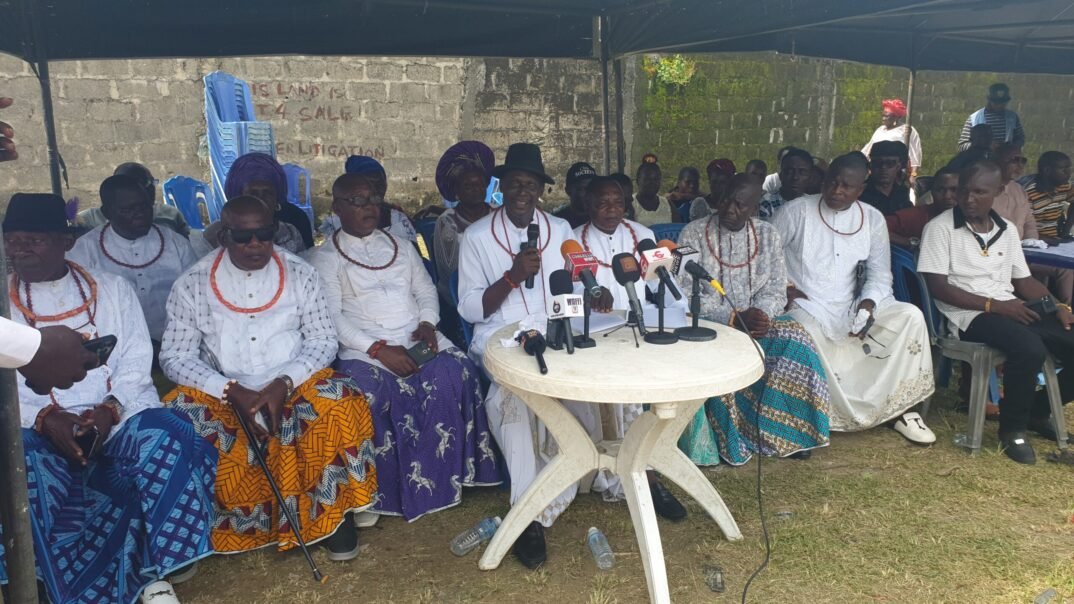
Leaders of the Ijaw ethnic nationality in Warri South Local Government Area of Delta State, have alleged plot by some forces to overturn the final report of the Supreme Court-ordered delineation exercise carried out by the Independent National Electoral Commission (INEC).
Addressing a news conference at Olabrakopre Community in Warri South Local Government Area, on Saturday, leaders of the Ijaw ethnic nationality in Warri South Local Government Area threw their weight behind the May 20, 2026 INEC wards and polling units delineation report, which was implemented following a Supreme Court judgment (Suit No. SC/413/2016).
Throwing their weight behind the report, the leaders in a joint statement signed by Ijaw Focal Person Hon. Denbo-Denbofa Oweikpodor and Comrade Moses Fiyebor, accused some top Itsekiri political figures of leveraging their political influence to frustrate the implementation of the new proposal.
Specifically, the Ijaw leaders alleged that a top politician of Itsekiri heritage is leading efforts to pressure INEC into withdrawing the newly allocated wards for Ijaw communities in Warri South.
Warning of the dangerous precedents of such interference, the group invoked the memories of the bloody Warri crisis (1997–2003)—which was triggered by the relocation of a local government headquarters—cautioning that current political maneuvering could easily destabilize the fragile peace in the area.
“We the Ijaw people of Warri South welcome the final report of the fresh delineation exercise which was released by INEC to stakeholders in Asaba, Delta State on Wednesday, the 20th day of May, 2026.

“The INEC final report to a very large extent reflects the reality on ground and we commend the commission for doing a very thorough job. We also accept the delineation of the Ijaw electoral wards and registration areas into Warri South Constituency II of the Delta State House of Assembly”, the statement read.
The group, however, said it was necessary to correct what it described as “misconceptions” allegedly being promoted by the Itsekiri ethnic nationality concerning the existence and status of Ijaw communities in Warri South Local Government Area.
According to the statement, some Itsekiri groups had allegedly been spreading narratives suggesting that the Ijaw people of Ogbe-Ijoh were not part of Warri South LGA.
“The fact that the Ijaw areas were balkanised into polling units, marginalised and denied political representation does not mean that the Ijaws do not exist in Warri South Local Government Area,” the statement declared.
To back their claims of deep-rooted indigeneity, the Ijaw leaders presented a catalog of historical and legal documentation including the 1928 Warri Township Assessment Report, A colonial document by Mr. Prethoroe identifying “Ogbe-Ijoh” as the original nucleus around which modern Warri developed.
The Ijaw leaders said the issue had earlier been raised during stakeholders’ meetings organised by INEC and had already been addressed by the electoral commission.
They stated that during meetings involving INEC officials and representatives of the Ijaw, Itsekiri and Urhobo ethnic nationalities at the Government House Annex in Warri on July 8, 2024, it was resolved that the Ijaw people were an integral part of Warri South LGA based on available intelligence reports, physical communities on ground and existing polling units.
The statement noted that INEC subsequently assigned field officers specifically to Ijaw communities during the delineation exercise carried out between July 10 and July 19, 2024.
According to the group, the officers covered Ijaw settlements that now constitute the newly created Ewein Ward 07, Bulou-Ama Ward 02, Ogbe-Ijoh Warri Urban Ward 12 and parts of GRA Ward 08.
The statement referenced the 1955 Western Region Laws of Nigeria No. 177 establishing the then Warri Urban District Council, which, according to the group, recognised four autonomous Ijaw wards identified as Alders Town B3, Ogbe-Ijoh Ward C1, Ogbe-Ijoh Ward C2 and Government Area F1.
The group further relied on historical records, including the 1928 Warri Township Assessment Report prepared by Mr. Prethoroe, which described Ogbe-Ijoh as the original settlement around which present-day Warri developed.
Quoting from the report, the Ijaw leaders said: “The original settlement, which in due course became the nucleus around which the population settled, was known as OGBE-IJOH.”
The group also referred to a 1923 letter written by Chief Dore Numa to the Resident of Warri Province as additional evidence supporting the historical presence of the Ijaw people in Warri township.
According to the statement, the restructuring of local government administration in 1976 led to the balkanisation of previously existing homogeneous Ijaw wards into minority polling units spread across Pessu, GRA, Bowen and Okere wards.
The Ijaw leaders alleged that the development weakened their political representation and denied them adequate participation in local administration.
“The fact that the Ijaw areas were balkanised into polling units, marginalised and denied political representation does not mean that the Ijaws do not exist in Warri South Local Government Area,” the statement added.
The group also maintained that several laws and judicial decisions had recognised Ogbe-Ijoh Kingdom as distinct from Itsekiri areas within Warri metropolis.
It cited the Chiefs Law of 1957, the 1979 Bendel State Traditional Rulers and Chiefs Edict, as well as the Delta State Traditional Rulers, Chiefs and Council Law, which recognised the Amaokosu of Ogbe-Ijoh as the prescribed authority over Ogbe-Ijoh lands and people.
The statement further referenced Appeal No. CA/AS/441/2016, decided on June 5, 2023, which it said affirmed the distinct status of Ogbe-Ijoh Kingdom within Warri metropolis.
On claims of court victories by the Itsekiri over Ogbe-Ijoh lands, the Ijaw leaders insisted that no judgment existed granting radical title over Ijaw lands in Warri metropolis to the Itsekiri ethnic nationality.
“It is important to state that the Itsekiris have no judgment against the Ijaws of Ogbe-Ijoh which confers radical title on them over Ogbe-Ijoh lands in Warri metropolis or anywhere else,” the statement said.
The Ijaw leaders warned that attempts to reverse the delineation exercise could create tension and destabilise the peace in Warri.
They recalled “the Warri crisis of 1997 to 2003, which followed the relocation of the headquarters of Warri South-West Local Government Area from Ogbe-Ijoh to Ogidigben”.
The Ijaw leaders, however, argued that their communities deserved more electoral wards than those presently created by INEC, insisting that if they had four wards as far back as 1955, it was only fair for the number to increase decades later.
“We therefore call for the creation of more electoral wards and state constituency for Ijaws in Warri South LGA and also urge INEC to disregard frivolous protests against the delineation exercise in Warri South LGA,” the statement added.






Aircraft Loses Door Minutes After Take-Off From Abuja, Makes Emergency Landing

Umahi Orders Reconstruction Of Benin-Asaba Highway, Reopens First Niger Bridge With CCTV, Solar Lights

Minimum Wage: NLC, FG Clash Over Timing of Fresh Wage Review

Yahaya Bello Fraud Trial: BDC Operator Reveals How N1.425bn Was Used To Pay Bello Children’s School Fees At AISA

Dokubo-Asari To Be Crowned Amanyanabo Of The Source Dec 19, As Tonye Princewill Chairs Coronation Committee

Ebenco Refinery Gets NMDPRA Approval To Introduce Hydrocarbons, Advances To Commissioning

Delta: Police Arrest Man For Attempted Armed Robbery, Stabbing Woman in Alifekede Village

Delta Police Arrest Three Over Theft Of N2m, POS Machine In Okwagbe Waterside

Oluremi Tinubu Pays Homage to Oba of Benin in Benin City

Delta NUJ Election: Oyowe Re-elected Chairman, Defeats Obieh

2027 Delta Central: Omo-Agege Accuses Dafinone Of Sponsoring Petitions, Says He’s Scared Of Election

‘No Vacancy’: Senators Endorse Akpabio for Second Term as Senate President

Donald Duke To Gov Diri: You’re A Local Champion Over Coastal Highway Opposition

2027: Why I Won’t Attend Every APC Campaign Rally – Tinubu

Isoko South Council Distributes Desks To Public Primary Schools In Delta