
FEATURES
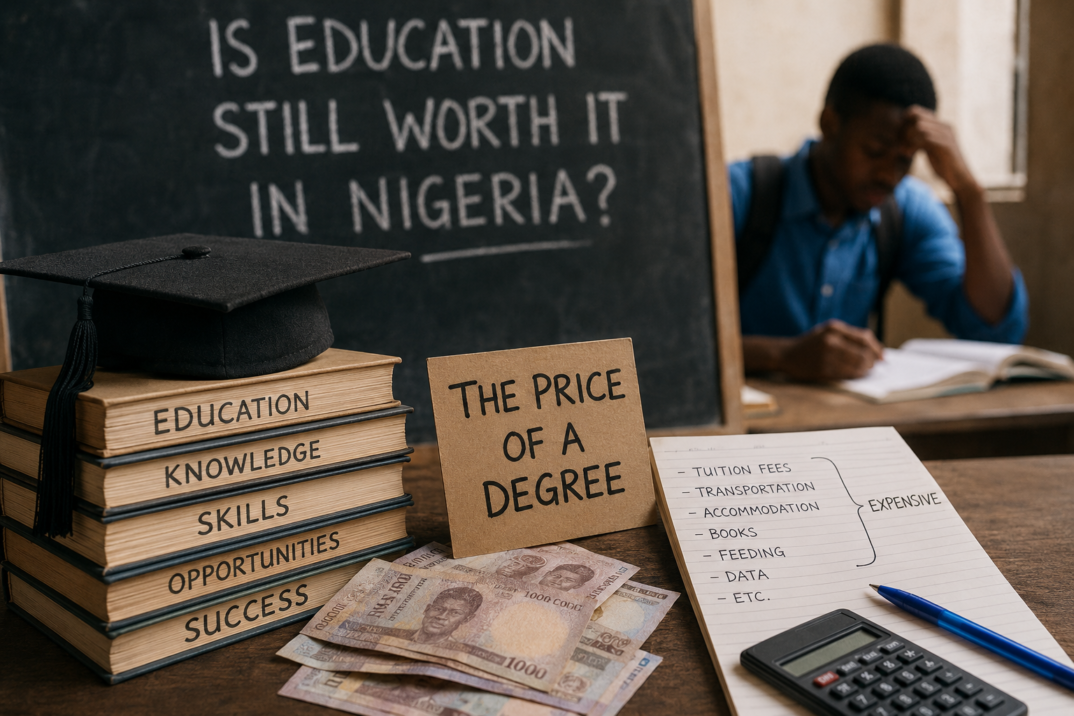
The Price of a Degree: Is Education Still Worth It in Nigeria?

By Oshiorelumhe Francisca Adoroh
The morning lecture had barely begun when a student quietly slipped into the classroom. She had just finished attending to customers from the small business she runs to support herself through school. Like many Nigerian undergraduates, her day had started long before the first lecture and would end long after sunset.
For many young Nigerians, education is no longer just about attending classes and earning good grades. It is a daily struggle to survive financially, balance academic demands, and hold on to the hope that a degree will eventually pay off.
“I learnt a skill so I could settle some bills without calling my family for money,” said Unutame Francisca Oghenro, a 200-level Journalism and Media Studies student at Delta State University, Abraka. While she still believes in getting a university education, she admits that a degree alone cannot guarantee success.
She is only one of many students trying to balance education with the demands of survival.
Elizabeth, a final-year Philosophy student at Delta State University, describes her university journey with one word: “Experiential.” The good, the bad, and the unexpected have all shaped her understanding of education and life.
“I am learning skills because I need multiple sources of income,” she said. To her, success depends less on possessing a certificate and more on what an individual chooses to do with the opportunities available.

This growing belief among students reflects a changing reality in Nigeria, where economic hardship, rising unemployment, and increasing school costs have forced many young people to rethink the purpose of education.
For some graduates, these realities become clearer after leaving the university gates.
A graduate of Industrial Technical Education from the University of Benin, who preferred to remain anonymous, entered adulthood with few expectations after researching the challenges Nigerian graduates face in the labour market.
While still in school, he worked different jobs to support himself and later secured contract employment before landing a full-time position months after completing his National Youth Service.
He does not regret going to school but believes the country’s education system has failed to prepare many graduates for the realities of the workplace.
“Our education is a disorientation,” he argued, describing a system that places too much emphasis on grades while practical skills receive little attention.
His concerns echo those of Mrs. Henry Faith, a Social Studies teacher.
According to her, one reason many Nigerians are beginning to question education is the visible gap between qualifications and outcomes.
“When people see a graduate hawking goods in traffic beside someone without a university degree who owns a successful business, the lesson is hard,” she explained.
She believes the country’s educational system remains too focused on examinations and memorization instead of practical skills, creativity, and critical thinking. Poor infrastructure, overcrowded classrooms, outdated curricula, inadequate funding, and frequent strikes have further weakened confidence in the system.
Yet, despite these challenges, she insists education still has value.
“A degree should not be the entire plan,” she said. “School is worth pursuing alongside a skill or trade.”
Parents, too, are caught between hope and hardship.
Emmanuel Idegbor, a father of four, admits that paying school fees and other educational expenses has become increasingly difficult due to the rising cost of living. Economic challenges have affected his children’s education, and he worries about what awaits them after graduation.
Still, he has not lost faith.
Asked whether he would continue investing in his children’s education if given the chance, his answer was immediate.
“Yes, I will.”
He also believes that skills should be introduced alongside formal education and remains convinced that school is still worth it despite the economic realities.
Across these conversations, one message emerges clearly. Nigerians are not abandoning education; they are redefining it.
Students are combining lectures with entrepreneurship. Graduates are seeking opportunities beyond their fields of study.
Teachers are calling for practical reforms. Parents continue to sacrifice for their children’s future while encouraging them to acquire skills that can provide financial security.
Perhaps the question facing Nigeria today is no longer whether education matters.
It does.
The bigger question is whether the current educational system is equipping young people for the future they will inherit.
For now, lecture halls remain full, parents continue to pay school fees, and students keep chasing degrees while learning skills on the side. They are not simply pursuing certificates; they are searching for security, opportunity, and a better life.
In a country where many believe that education alone is no longer enough, hope has evolved. It now comes with a degree in one hand and a skill in the other.
Submitted by Oshiorelumhe Francisca Adoroh, a 200-level Journalism student of Delta State University, Abraka.






Oborevwori’s CPS Ahon Meets New Delta NUJ Exco, Calls For Closer Synergy With Government

Full List: Tinubu Nominates 4 New INEC Commissioners, 2 RECs — See Names, States

NNPC Confirms Rivers Pipeline Explosion, Residents’ Homes and Businesses Damaged

Police Raid Cult Anniversary Party in Asaba, Arrest 95 Suspected Cultists, Recover Pump-Action Guns

Aircraft Loses Door Minutes After Take-Off From Abuja, Makes Emergency Landing

Umahi Orders Reconstruction Of Benin-Asaba Highway, Reopens First Niger Bridge With CCTV, Solar Lights
Minimum Wage: NLC, FG Clash Over Timing of Fresh Wage Review

Yahaya Bello Fraud Trial: BDC Operator Reveals How N1.425bn Was Used To Pay Bello Children’s School Fees At AISA

Dokubo-Asari To Be Crowned Amanyanabo Of The Source Dec 19, As Tonye Princewill Chairs Coronation Committee

Ebenco Refinery Gets NMDPRA Approval To Introduce Hydrocarbons, Advances To Commissioning

Delta: Police Arrest Man For Attempted Armed Robbery, Stabbing Woman in Alifekede Village

Delta Police Arrest Three Over Theft Of N2m, POS Machine In Okwagbe Waterside

Oluremi Tinubu Pays Homage to Oba of Benin in Benin City
Delta NUJ Election: Oyowe Re-elected Chairman, Defeats Obieh

2027 Delta Central: Omo-Agege Accuses Dafinone Of Sponsoring Petitions, Says He’s Scared Of Election