
OPINION
THE BALLOT IS OUR VOICE: WHY YOUTH PARTICIPATION, BY MALECHI CHUKWUKA JUDE

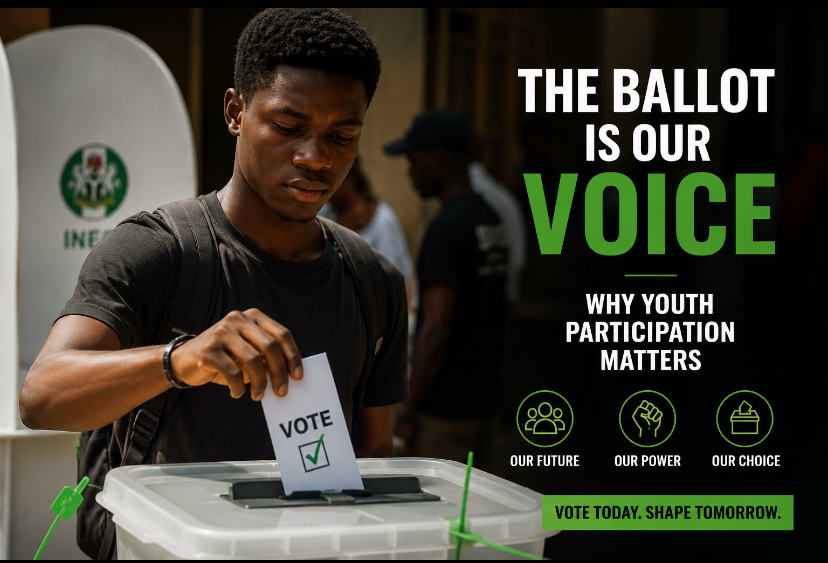
The ballot is more than a piece of paper placed in a ballot box; it is the voice of the people. It empowers citizens to choose their leaders, influence government policies, and shape the future of their nation. Every decision made by elected leaders affects both the young and the old, making participation in elections a civic responsibility for all.
I vividly remember my primary school days when we sang the popular song, “Parents, listen to your children; we are the leaders of tomorrow.” We usually sang it at the end of every morning assembly as a reminder that children would one day become the nation’s leaders. Nearly two decades later, I still remember those words. However, despite hearing that message throughout my childhood, I have rarely seen young people occupy the highest executive positions in Nigeria, particularly the presidency.
During my research, I discovered that before 2018, executive political offices in Nigeria were largely reserved for older citizens. A coalition of youth and civil society organisations, led by human rights activist Samson Itodo, championed the Not Too Young To Run campaign. Despite resistance from some politicians, the bill was eventually signed into law by President Muhammadu Buhari on May 31, 2018. The law reduced the minimum age requirement for presidential candidates from 40 to 35 years and for members of the House of Representatives from 30 to 25 years, while the age requirement for governorship remained 35 years.
Although there is a minimum age requirement for political offices, many Nigerians believe there should also be a reasonable maximum age limit. Some lawmakers have proposed a maximum age of 60 years for presidential candidates. While this proposal generated debate, it did not progress beyond the second reading.
The youth are often described as the leaders of tomorrow, but tomorrow begins today. Many young Nigerians ask whether they have been left behind in governance. The answer is no. Young people constitute the largest segment of Nigeria’s population, giving them enormous political potential. Unfortunately, tribalism, ethnic divisions, and a lack of unity have weakened their collective influence.
Youth participation in politics goes beyond voting; it involves active engagement in governance, advocacy, and nation-building. Every citizen deserves the opportunity to express their views and contribute to decision-making.
Many Nigerians often ask whether their votes truly count. The answer is yes—our votes matter when we reject vote buying and electoral malpractice. Young people should come out in large numbers, vote responsibly, and elect competent leaders who can be held accountable.
Nigeria has enjoyed uninterrupted democratic rule for over two decades. Abraham Lincoln famously defined democracy as “government of the people, by the people, and for the people.” If young people remain absent from politics, they cannot expect to shape the future they desire.
Another important reason why youth participation matters is that young people bring fresh ideas, innovation, and energy to governance. As the generation most affected by issues such as unemployment, education, technology, insecurity, and climate change, they understand these challenges firsthand. Their active involvement in politics can lead to policies that better address the needs of the younger population while promoting national development. A government that includes young people is more likely to embrace creativity, digital transformation, and progressive reforms that benefit society as a whole.
Beyond voting, young people must also hold elected leaders accountable after elections. Democracy does not end at the ballot box; it continues through active citizenship. Young Nigerians should monitor government policies, participate in public discussions, attend town hall meetings, and use lawful means to demand transparency and accountability from public office holders. When citizens remain engaged after elections, leaders are more likely to fulfil their campaign promises and govern in the interest of the people. An informed and active youth population is essential for building a democratic society where good governance thrives.
Furthermore, political participation provides young people with valuable leadership experience. By joining political parties, youth organisations, student unions, and community development groups, young Nigerians can develop the skills needed for effective leadership. These experiences prepare them to make informed decisions, represent the interests of their communities, and contribute meaningfully to national development. Rather than waiting for opportunities, young people should actively prepare themselves to become responsible and visionary leaders.
The ballot remains one of the most powerful tools for promoting good governance and national development. Every meaningful change begins with individuals.
Malechi Chukwuka Jude, a law student of Delta State University, Abraka writes from Oleh8






”They Will Come After Us Next” — Atiku Sounds Alarm on ‘Assault on Democracy’

THE BALLOT IS OUR VOICE: WHY YOUTH PARTICIPATION, BY MALECHI CHUKWUKA JUDE

Resident Doctors Extend Strike Ultimatum by Four Weeks, Threaten Nationwide Industrial Action

Priced Out of Education: How Rising House Rent Is Threatening Nigerian Students’ Dreams

IPC Trains Delta Online Publishers on Ethical Election Reporting, Fact-checking

FCT CP to Officers: Stop Extorting or Quit the Force

Oshiomhole Backs Death Penalty for Kidnappers, Bandits in Edo

How China-Bound Businesswoman was Nabbed With 7.5kg Cocaine, ₦12.4bn Cannabis at Lagos Airport by NDLEA

How Operation KO S’AYE Delivers Major Blow to Kidnappers, Rescues Five Victims in Lagos-Ogun Forests

THE HIDDEN COST OF BEING A STUDENT, BY ANGEL EGHAREVBA OSARETIN

State Police: Ekweremadu’s Foresight, Tinubu’s Courage, Mbah’s Example

Oborevwori Hails Police’s Arrest Of Electric Cable Vandals

WHY NDC MAY NOT BE ON THE BALLOT IN 2027: FACTS NIGERIANS NEED TO KNOW, BY UFUOMA EGBE

NIPR, Stakeholders Say Leadership, Accountability Panacea to Nigeria’s Sustainable Development
