
NEWS
Revamp of Delta Ports Takes Center Stage as WACCIMA Gathers Stakeholders in Warri Amid NPA’s Moves to Relocate Maritime Operations from Lagos

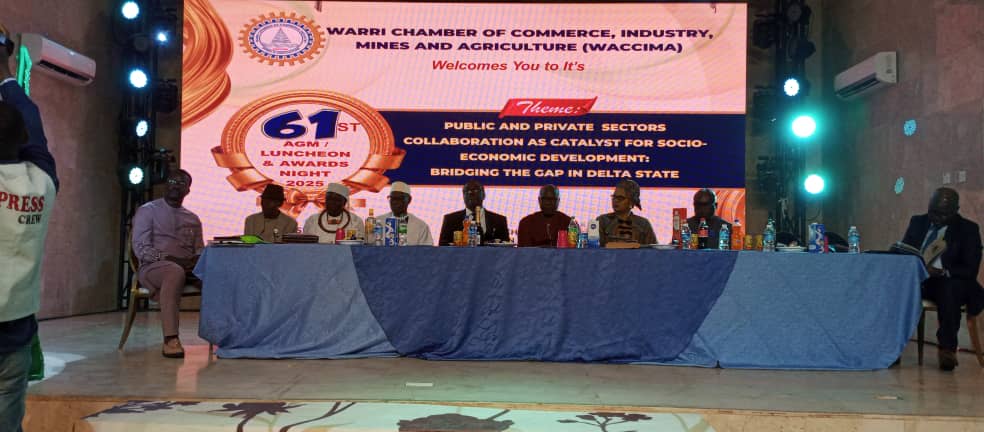
Stakeholders, including WACCIMA, Delta state government officials, and industry leaders, last week gathered in Warri, the commercial hub of the state, emphasizing the urgent need to revamp the Delta ports, as the Nigeria Ports Authority (NPA) is reportedly considering relocating some maritime operations from Lagos to Warri.
The call was made during the 61st WACCIMA Annual General Meeting, which focused on harnessing public and private sector collaboration to drive social-economic development in Delta State.
The call was made at the 61st Annual General Meeting/Luncheon/Award Night of the WACCIMA with the theme “Public and Private Sector as Catalyst for Social-economic Development: Bridging the Gap in Delta State,” held at The Monarchy Event Centre in Effurun, Uvwie Local Government Area of the State.
In a keynote address on the theme delivered by the guest lecturer, the Managing Director and Chief Executive Officer of Wellmann Group of Companies, Deacon Chris Iyovwaye, proposed a seven-point agenda and practical framework for bridging the development gap in Delta state, saying that Delta is well positioned with its coastline, rivers, and inland waterways to become the marine logistics hub of West Africa.
Deacon Iyovwaye, who was represented by Mr. Henry Scott-Orovwuje, said that Delta is blessed beyond measure in many facets of the state economy, including oil, gas, deep waterways, fertile land, human creativity, maritime advantage, and a vibrant youth population.
He noted that despite the high economic potential, the state is still confronted with huge infrastructural deficits in industrial diversification, in youth engagement, in policy alignment, and in the synergy between public institutions and private-sector capability.
The Wellmann Group boss said meaningful progress only occurred when public institutions laid the foundation and private enterprises provided the engine.
He cited global examples such as Singapore, the UAE and Norway, where development was made possible because government policies aligned with private-sector competence.
Unveiling the seven-point proposal, Oyovwaye urged the state government to create a Delta Public-Private Development Charter, a Delta Investment and Industrialization Council, the Warri-Effurun Twin-City Economic Zone as well as operationalization of modular refineries and petrochemical hubs.
He also recommends the development of agro-industrial corridors across the senatorial districts, reviving and modernizing technical and vocational education, and establishment of an Annual Delta Economic Dialogue.
Iyovwaye added that the private sector in Delta State had already demonstrated capability, referencing the successful relocation of a 3,800-ton offshore platform by indigenous experts.
He said such accomplishments proved that the state could execute world-class projects when supported by enabling public policies.
He identified agriculture as a major area for growth, saying Delta State had the potential to become Southern Nigeria’s agro-processing hub.
According to him, the government must provide land, rural access roads, and incentives, while investors must focus on mechanisation, processing, and export chains.
“Delta state can become a food and agro-processing center of Southern Nigeria. But this requires coordinated action; government must provide land banks, rural access roads, tax incentives, and security for farmlands; the private sector must invest in mechanization, processing plants, storage systems, and export value chains.
On the blue economy, Iyovwaye said Delta State’s waterways placed it in a strong position to become the marine logistics centre of West Africa.
He said the region could support shipyards, fisheries estates, oil-servicing hubs, and maritime academies, urging both the government and the private sector to work together to create digital jobs and innovation clusters.
Iyovwaye further stressed the importance of preparing youths for a technology-driven future, calling for investments in artificial intelligence, robotics, fintech and smart logistics.
While commending WACCIMA for consistently bridging the gap between government and private enterprise, he urged them to use their vital platform to reshape the state’s economic direction.
Speaking, the representative of Governor Sheriff Oborevwori, Commissioner for Trade and Investment, Hon. Samuel Oligida, said it was distressing that despite having more than one port, none was functioning.
Oligida, who was also represented by the Director of Commerce, Mr. Felix Oseji, said the situation was unacceptable considering that most imported goods were destined for the South.
He explained that ports played a central role in the prosperity of any economy, noting that Delta State needed functional seaports if it was to attract investments and stimulate growth.
He noted that the ports must be brought back to life to enable citizens access original goods and boost commercial activities.
Oseji, who averred that with functional ports, rail transport will naturally come to play, urged the private sector to take a firm position on the issue, stating that the government was ready to collaborate.
“The state of the port in Warri is something not to be happy about. It is sad that we have more than two ports and none is functioning.
“I see no reason why the ports should be lying fallow taking into the consideration that containers brought into the country are headed to the South yet we have ports that are not functioning. It’s not something to be happy about.
“The wealth of any economy is in the ports. We need a functional port and we need to employ everything possible to ensure our ports come alive again.
“If this is done, development will be evident in Warri and the state as a whole. By virtue of the presence of ports, we can have access to original goods.
“The private sector should do a position and sendy to us and we will escalate it. What is wrong with having more than five ports in Nigeria?”
In his remarks, the President of WACCIMA, Engr. Anthony Okoh, emphasised that the revitalisation of the Delta Ports had been a decade-long concern.
He said stakeholders were relieved that, after persistent advocacy, the government had finally begun paying attention to the Ports, urging authorities to “accelerate its completion” to unlock the economic potential of the Niger Delta.
Engr. Okoh said that the ongoing infrastructural work across Warri was commendable, noting that it was making the city more attractive for investments.
He called on the government to ensure that both international and indigenous oil companies relocate their head offices to the Niger Delta, insisting that “the era of using our resources to develop other parts of the country must stop”.
In the same vein, the Chairman of the Board of Trustees of WACCIMA, Chief Moses Orogun, stressed that reopening the ports remained the fastest way to revive Warri’s economy.
He said the city would experience instant improvement once port operations resumed.
Orogun appealed to business leaders to take up the matter with policymakers, insisting that growth could not happen without their active involvement.
He said, “The government alone cannot do it”, adding that business interests must push for action because politics differed from commerce.
Highlights of the event included entertaining questions from the stakeholders, some of whom harped on the need for enhancing the environmental aesthetics of Warri to attract investment.
Corporate organizations and individuals received excellence awards, including Tantita Security Surveillance Nigeria Ltd (TSSNL), the founder of the Word of Life Bible Church and former president of the Christian Association of Nigeria (CAN), Pastor Ayo Oritsejafor, and Safari Pharmacy, among others.
The AGM brought together business leaders, technocrats, policymakers, and industry experts who agreed that reviving Delta Ports and improving infrastructure, as the Oborevwori government is doing, was critical to repositioning Delta State for long-term growth.


Oborevwori Boosts Delta Healthcare With 3 MRI Machines, 700 Health Workers

2027: Nwokocha Inaugurates Association of Igbo Democrats Delta Chapter, Endorses Peter Obi

BREAKING: Tinubu Returns to Nigeria, Says ‘I’m Hale, Strong and Ready to Work’

Edo Court Sentences Four to Death Over Airport Road Kidnap

Okpebholo: I Started Casting Out Demons at 17

Apostle Joshua Selman Prophecy: Cleric Says High-Ranking Politician Will Die Soon

Police Recover 28 Human Skulls, Bones from Suspected Criminal Camps in Abia

BREAKING: Police Arrest Delta Education Commissioner Ashibogwu, Four Others Over Deputy Director’s Death

DSS Secures Death Sentence for Suspected Kidnapper Over Sokoto Killings

‘I Was Misled’ — Kenneth Okonkwo Changes Position on Peter Obi’s Anambra Debt Record

He Is Hale and Hearty — Presidency Speaks on Tinubu’s Return

Still on Osun and the election that was! (2)

Adeda’s Death: Omo-Agege Demands Full Probe, Asks Commissioner Ashibogwu to Step Aside

Tinubu: Nigeria Has Finished Making Sacrifices, Better Days Ahead
