FEATURED
INEC Boss, Presidency Under Fire Over Alleged Defiance of S’Court-Ordered Warri Ward Delineation


... as Ijaw, Urhobo Leaders threaten to petition NJC, accuse Presidency of hijack
The Chairman of Independent National Electoral Commission (INEC). Prof. Joash Amupitan (SAN) as well as the Presidency have incurred the wrath of indigenous people of Ijaw and Urhobo ethnic nationalities of Warri Federal Constituency over alleged failure to implement the Supreme Court-ordered ward delineation exercise.
This comes as the ethnic groups are threatening to drag INEC Chairman before the National Judicial Council (NJC) over the commission’s delay in implementation of the delineation report.
Addressing a joint press conference in Warri, on Monday, leaders of the ethnic nationalities and community stakeholders, accused the electoral umpire of stalling the implementation of the fresh constituency delineation report presented on May 20, 2026.
The approved plan, unveiled by INEC National Commissioner Alhaji Abdulrazaq Tukur Yusuf, established 20 new registration areas and two additional state constituencies across the Warri North, South, and South-West Local Government Areas ahead of the 2027 general elections.


According to the leaders, despite the initial assurances that political parties could immediately begin primaries based on the new structure, INEC has allegedly frozen the process.
The coalition claims the sudden paralysis is the result of direct executive overreach from the Presidency and the office of the National Security Adviser (NSA).
Reading the joint press release, High Chief Godspower Gbenekama, flanked by other prominent leaders from the ethnic groups including Hon. Denbo-Denbofa Oweikpodor and Chief Femi Okumagba, expressed deep disappointment in Amupitan’s leadership of INEC.
They noted that as a senior lawyer and law professor, Amupitan’s apparent defiance of the apex court’s ruling in the decade-long case (SC/413/2016: Hon. George U. Timinimi & Ors v. INEC) severely undermines Nigeria’s democratic and judicial integrity.
“We are giving the INEC Chairman a maximum of two days to rectify this,” Gbenekama warned, supported by crowds of protesting youths and women.
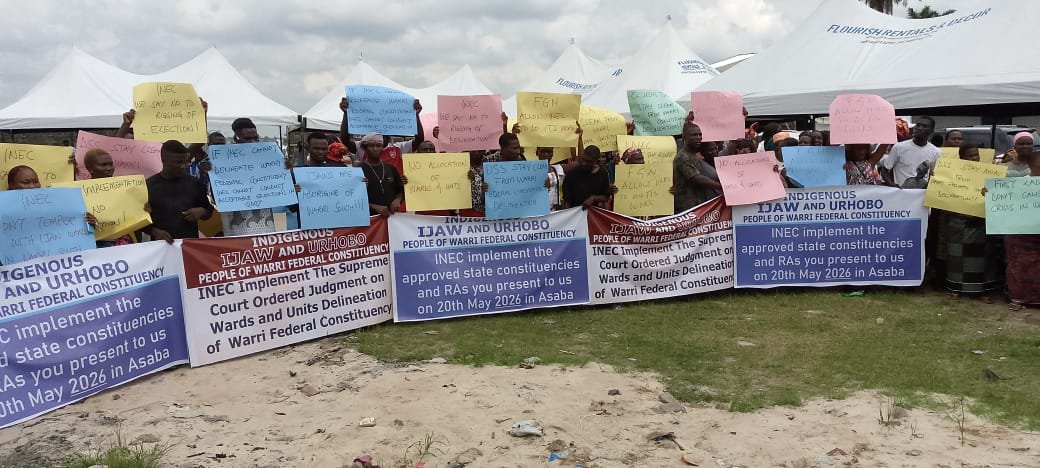

“If this defiance continues, we will formally petition the NJC disciplinary committee to hold him accountable.”, he added.
The leaders argued that any interference from the Presidency violates Section 161 of the 1999 Constitution, which guarantees INEC’s operational autonomy, as well as Section 287 (2), which legally binds all state institutions to enforce Supreme Court verdicts.
They further dismissed security concerns raised by the NSA’s office, labeling them a “smokescreen” intended to alter the delineation report to unfairly favour the neighbouring Itsekiri ethnic group.
Evoking dark historical precedents, the coalition drew parallels to the 1952 political manipulations by the old Western Region government that ignored Warri’s multi-ethnic reality.
They also warned that tampering with the May 20 report could reignite the devastating ethnic conflicts that ravaged Warri between 1997 and 2003, which were triggered by similar administrative interference.
The Ijaw and Urhobo leaders however called on global democratic observers to closely monitor the situation, insisting that INEC must immediately resume the electoral process using the unaltered, original delineation report.