FEATURED
Judiciary Has Become the ‘Lost Hope’ of the Common Man – Mike Igini


Firebrand human rights lawyer and former Resident Electoral Commissioner of the Independent National Electoral Commission (INEC), Mr. Mike Igini, Esq., has criticized the judiciary for a post-election role that he argues has caused many Nigerians to lose confidence and hope in the system.
He spoke on Thursday in Asaba during the 2026 edition of the BEL Dialogue, an annual public policy forum organized by Bel Media Consult Limited, publishers of Ndokwa Reporters and The Brief.
Speaking as Chairman of the occasion on the theme, “Democracy That Works: Bridging the Gap Between Votes, Results and Institutional Accountability,” Igini lamented the drift in democratic principles, stating that the nation’s democracy has slided to the point where election outcomes are determined by the courts.

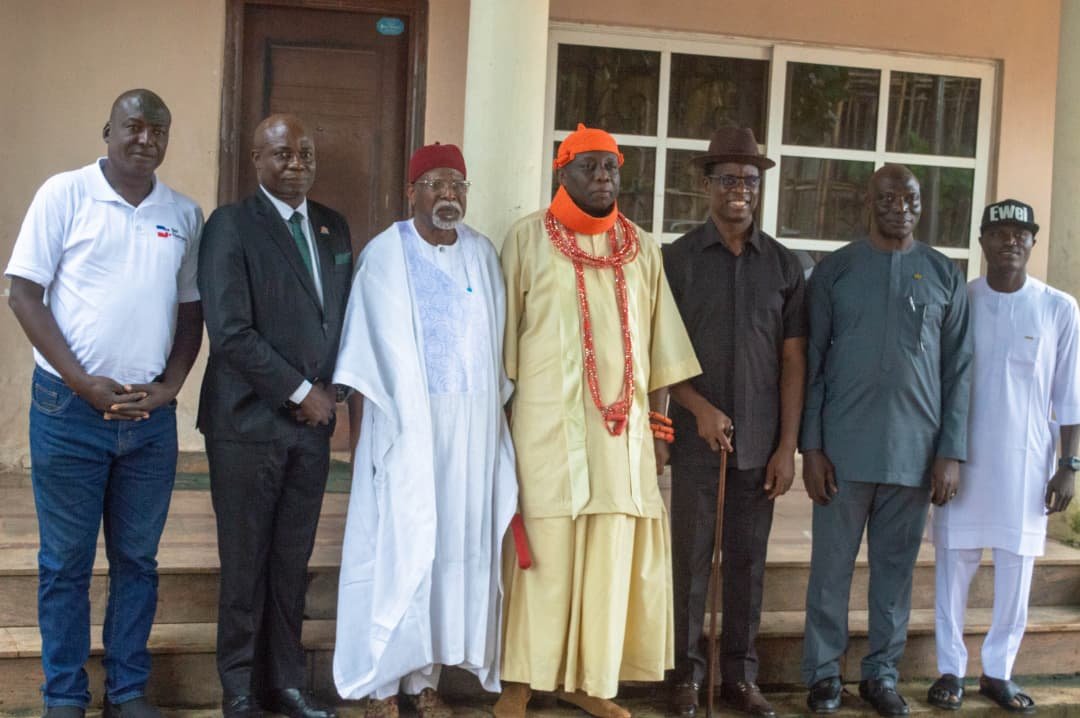
2rd from right: Mr Emmanuel Enebeli, Publisher Ndokwa Reporters and Executive Secretary Bel Dialogue Advisory Board, former INEC REC, Mr. Mike Igini, Esq., the Chairman of the BEL Dialogue Advisory Board, Pharm. Paul O. Enebeli, (3rd left) during a courtesy visit to the palace of His Royal Majesty, Asagba of Asaba, Obi (Prof). Epiphany Chigbogu Azinge, SAN prior to event, the 2026 edition of the BEL Dialogue, an annual public policy forum organized by Bel Media Consult Limited, publishers of Ndokwa Reporters and The Brief.
“Painfully and regrettably, the judiciary, which ought to be the last hope of the common man, is now the lost hope of the common man. Today in our country, we have degenerated to a point where it is the court that determines which party will be on the ballot paper,” Igini said.
Noting that the country will head to the polls in less than six months, he emphasized that the 2027 election will be more than a test due to lived experiences.
He highlighted that citizens are asking critical questions regarding whether their votes will count and if the elections will be free, fair, and credible.
Reviewing Nigeria’s 27 years of uninterrupted civil rule since 1999, Igini noted that periodic elections should offer a renewal of sovereignty where the electorate evaluates the performance of elected officials.


Reflecting on his time in service alongside Professor Attahiru Jega, appointed in 2010 by President Goodluck Jonathan, Igini recalled the introduction of technological systems designed to safeguard the ballot. These included the card reader to ensure “one person, one vote” during the 2011 and 2015 elections, which departed from the substandard processes of 2003 and 2007.
He explained that the subsequent transition to the Bimodal Voter Accreditation System (BVAS) and the INEC Result Viewing Portal (IReV) was intentionally designed to ensure election results were finalized at the polling units, preventing alteration at ward or local government collation centers. Prior to 2022, these systems successfully managed 105 elections, including five governorship contests, without challenges.
However, Igini stated that by the 2023 elections, historical electoral disruptions resurfaced due to sabotage. While the Senatorial and House of Representatives results were transmitted, the presidential election transmission failed due to an unexplained “glitch,” severely damaging public confidence.
“On 8 June 2010, President Goodluck Jonathan, a man voting for due process and good elections, appointed Professor Attahiru Jega. Three of us from civil society were appointed to give meaning and purpose to the ballot as the best means of expression of the will of the people in a democracy.
“In that regard, we established systems and processes to address historical challenges of election service delivery in our country. We started with the card reader to ensure the principle of one person, one vote.
“The 2011 elections and the 2015 elections were a remarkable departure from the past. The 2003 and 2007 elections did not meet both domestic and international standards.
“We then transited to the era of the BVAS. We designed it to ensure that nobody or group of persons is good enough to lead without the consent of the people.
“We used the BVAS and the IReV to ensure that when a Nigerian votes at a polling unit, that outcome should not be altered at the Ward Collation Center or Local Government Collation Center.
“That is why we decided to have IReV so that from the polling unit the result will be there for everyone to see. In which case it will be difficult for the Ward Collation Officer or Local Government Collation Officer to alter the results.
“We used it to conduct 105 elections including off-season elections and five governorship elections before we left office in 2022. Those elections were never challenged.
“By the 2023 elections, all the known electoral evils resurfaced across the country. It was impossible for “tilapia” to vote with BVAS.
“But what happened? Just one thing: sabotage.
“There are three elections: Senatorial, House of Representatives, and Presidential elections. Two were transmitted. But the presidential election was sabotaged. We heard about a “glitch.” That was what dropped public confidence and trust in the electoral process.
“Otherwise it was a successful process because an Okada rider won election in many places. But it was that presidential election and the unexplained glitch that eroded public confidence.
“That is why every election is a test. The 2027 election is going to be more than a test because the power belongs to the people”.
This drop in trust is reflected in declining voter turnout statistics: 57.53% in 2011, 43.7% in 2015, 34.8% in 2019, and a historic low of 26.7% in 2023. Igini noted this clear trend of citizen withdrawal from the democratic process.
He warned that elected officials are increasingly accountable to godfathers rather than the electorate because mandates are being compromised. While INEC serves as the referee, the security agencies and the judiciary must act as the delivery vehicles that protect democracy, he added.
“We designed all the processes to ensure that the winner of an election must be determined finally and conclusively at the polling unit, not in the court of law,” he added.
Continuing, he said; “Democracy is good. The whole essence of its embrace is because it is about participation and accountability, the process of human development.
“The commission saddled with the responsibility to midwife democratic competition must be above board.
“The ill of democracy can only be cured by more democracy, by more engagement, by more dialogue”.
Igini urged participants to remain practical and non-partisan in identifying policy solutions to bridge these gaps. He called on Nigerians to protect their votes in 2027 to ensure democracy ultimately serves the majority and leaves a heritage of hope for future generations.
“Let us be honest and identify what works and what has not worked well so that it will form part of a public policy document from this engagement. We should be practical in our engagement, not partisan.
“As we go into the 2027 election, we must have it in mind that when you cast a vote, you are voting for yourself and for your own good. You must protect your vote.
“In the final analysis, democracy must serve the interests of the greatest majority of our country.
“It should be said that this generation of Nigerians, in our own time, did what was right by giving not only to ourselves, but to future generations whose faces we are yet to see and whose names we may never know. All of whom should be able to say that indeed we left behind for them a heritage of hope”, he added.