FEATURES
UPDATED: ‘We Cannot Keep Teaching Science Without Laboratories’ – Women Chemists Plead With NDDC, Others


The Delta State Coordinator of Women in Chemistry (WIC), Dr Sarah Nwinee, has appealed to the Niger Delta Development Commission (NDDC), the North East Development Commission (NEDC) and other intervention agencies to prioritise education by equipping schools with functional science laboratories.
Dr Sarah Nwinee, made the appeal during the 2026 International Union of Pure and Applied Chemistry (IUPAC) Global Women’s Breakfast, held at the Petroleum Training Institute (PTI), Effurun, Delta State.
The hybrid event, themed “Many Voices, One Science,” brought together women chemists, academics, industry professionals and secondary school students to celebrate achievements in the chemical sciences, foster collaboration, and inspire the next generation of female scientists.

Speaking at the gathering, Dr Nwinee expressed deep concern over the deteriorating state of science education in Nigeria, noting that thousands of students are being prepared for examinations such as WAEC without ever stepping into a laboratory.
“Many schools no longer have functional laboratories, yet students are expected to sit for exams that require practical knowledge,” she said.
“I appeal to the NDDC, NEDC and other relevant agencies to focus on education. You cannot teach science in the abstract and expect excellence. Our children deserve better.”


Dr Nwinee, who has led Women in Chemistry since 2021, described the 2026 breakfast as particularly significant, marking her final outing as coordinator. She expressed gratitude that the organisation successfully secured sponsorship to expand its flagship quiz competition—raising the prize money fivefold from N50,000 to N250,000 for the winners.
“The quiz is not merely a contest,” she explained. “It is a strategy to help girls thrive. We increased the prizes so that students would read, prepare rigorously and take their studies seriously.”
‘Teach Science As Life, Not Abstraction’
Delivering the keynote address, Dr Mariefel Olarte urged scientists to champion transparency, competence and independence in their work. Drawing an analogy, she likened the scientific journey to riding a bicycle: “Balance requires constant movement.”
In a technical session titled “Enhancing the Contribution of Chemists to Sustainable Oil and Gas Development,” Simon Seaton, Chief Executive Officer of the Society of Petroleum Engineers, called for a more deliberate integration of chemistry into Nigeria’s petroleum value chain.
Professor Ellas Elemike, Chairman of the Chemical Society of Nigeria, Delta Chapter, stressed that attracting more girls to chemistry demands a pedagogical shift.
“Science should not be taught as something abstract,” he said. “It is life. Through our ‘Train the Trainer’ programme, we are helping secondary school teachers move beyond theory to show students that chemistry is all around them.”
He added that increased sponsorship had enabled the organisation to raise prize money significantly, reinforcing the message that excellence in science is both recognised and rewarded.
‘What a Man Can Do, a Woman Can Do Better’
Professor Mary Edema, of the Federal University of Petroleum Resources, Effurun (FUPRE), described Women in Chemistry as a vital support network for female chemists across disciplines—from petroleum chemistry to biochemistry.
“We come together to help one another in research and administration, to mentor and to show young girls that chemistry is not beyond them,” she said. “If other women can do it, so can you.”
On the challenge of balancing professional and domestic responsibilities, she advised: “Women must not overload themselves. Time management is everything. You must know when to be in the laboratory and when to be at home.”
Professor Doris Ogeleka, former Deputy Vice-Chancellor (Administration) at FUPRE, delivered a presentation titled “Building Bridges: Inclusivity in Science Communication,” in which she identified gender bias as a persistent obstacle.
“Sometimes, our male counterparts assume they can do better,” she said. “But when we come together, we remind ourselves that what a man can do, a woman can do—often better. Our place is not only in the kitchen. Our voices must be heard, recognised and valued.”
Victory for Demonstration Secondary School
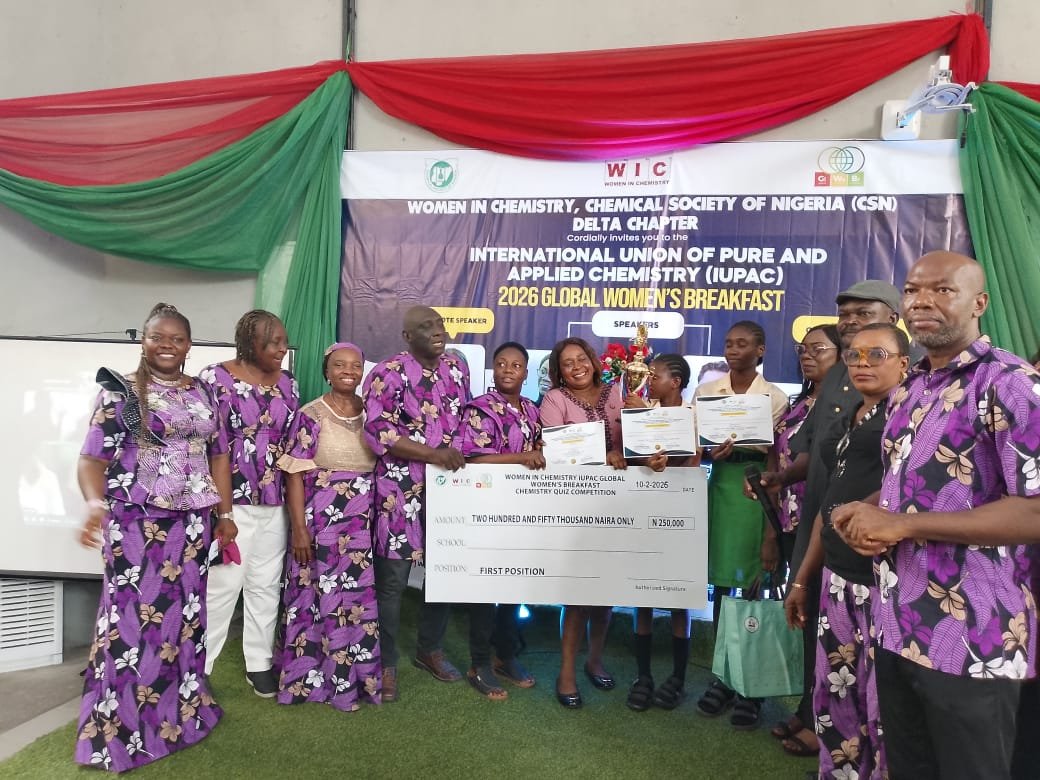
The event also featured a keenly contested quiz competition among nine secondary schools in Delta State. After a rigorous contest, College of Education Demonstration Secondary School emerged victorious, clinching the N250,000 grand prize. Ogbe Secondary School and Challenge Academy took second and third place, winning N150,000 and N100,000 respectively.
Speaking after their triumph, winners Ezimadu Emmanuella and Chukwuka Ngozi Favour beamed with pride. “We find chemistry intriguing,” they said. “This competition has pushed us to study even harder. We are grateful to the organisers for believing in us.”
The 2026 IUPAC Global Women’s Breakfast once again underscored the urgency of investing in science education—and the determination of women chemists to ensure that no girl is left behind.