
FEATURED
7 Things You Need To Know About FG’s N5,000 Cash Transfer To The Poor

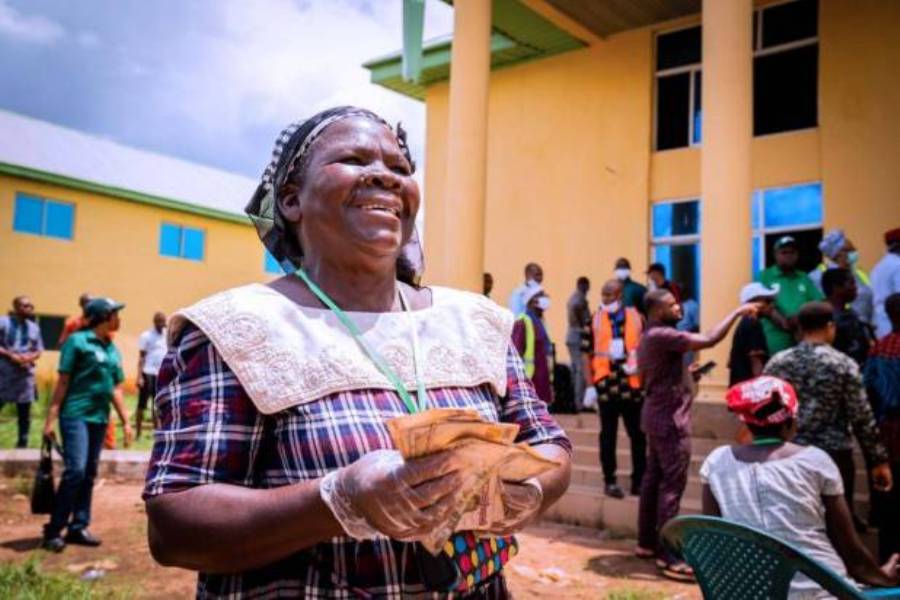
Much dance and song is being made about the Federal Government’s ongoing disbursement of N5,000 to the poor and indigent around the country.
The decibel level has increased since the launch on Tuesday January 19, 2021 by the Vice president Professor Yemi Osinbajo of the Rapid Response Register for the Covid -19 Cash Transfer to urban and rural poor.
Many commentators have asked where the money is coming from, how the poor were identified and plans for sustainability. These are valid questions and deserve answers.
First, let us look at the key word; Covid-19 has thrown up the world’s lack of preparedness for such a massive emergency. Countries from the US to the UK, Canada to Italy, and Afghanistan to Algeria were all thrown for a loop and have had to evolve emergency measures to cope with the pandemic.
At the tail end of December, 2020 the US congress signed about $900m in Covid-19 relief; Canada paid unemployed citizens CAD2000 monthly in 2020, Afghanistan committed 1.6% of its GDP to Covid-19 relief with rural poor households getting $50 monthly while urban poor households got $100 per month. Additionally the Afghan government gave food and waived electricity bills.
Why can America and Canada, two countries Nigerians are running to, give Covid-19 relief and Nigeria, a poor country cannot?

Here are 7 facts everyone interested in the disbursements must know in order to provide clarity to others.
- When did FG’s Cash Transfer Start? Cash transfer is not new and did not start with the Ministry of Humanitarian Affairs Disaster Management and Social Development which was created in August 2019. The National Cash Transfer Programme was introduced by the Federal Government in 2016 in partnership with the World Bank to fortify social safety nets and establish a social protection system in Nigeria. This is in line with the President Buhari led Government’s Social Investment agenda of eradicating poverty and promoting shared prosperity amongst the citizenry.
- What was the design? Designed as the Household Uplifting Programme-Conditional Cash Transfer (HUP-CCT), it involves the release of a monthly stipend of N5,000 to the poorest and most vulnerable Nigerian households, beginning in rural communities. The need for social nets has been underlined by the Covid-19 pandemic. As at December 2020, the programme operated in 33 states of the country and the FCT. A total of 1,414,983 beneficiaries with 7,068,629 individual household member beneficiaries had been enrolled, covering 487 Local Government Areas, 4,716 Wards and 37,628 Communities. The programme targets to cover all States of the Federation by March 2021.
- How is the programme implemented? Contrary to claims of lacking a proper implementation structure, the Programme has a clearly defined implementation structure with an electronic based beneficiary enrolment system that focuses on the Poor and Vulnerable Households (PVHHs) mined from the National Social Register. The PVHHs are identified through a combination of geographic and community based targeting mechanisms conducted by the various State Operating and Coordinating Units (SOCU) under the supervision and guidance of the National Social Safety Net Co-ordination Office (NASSCO). The Community Based Targeting (CBT) mechanism is used for the targeting process.
- How is the list of poor people compiled? Despite insinuations, the list is not compiled by the Ministry of Humanitarian Affairs Disaster Management and Social Development. The database of Poor and Vulnerable Households (PVHHs) is generated at the state level and domiciled at State Ministries of Planning. This information is accessible through the National Social Safety Net Project (NASSP) website. At the commencement of the programme in September 2016, Memoranda of Understanding were signed between the FG and all states. Some states committed to the programme instantly while others joined in later. This clearly put some states in the lead ahead of others in the generation of the State Social Register of Poor and Vulnerable Households. Currently, State Social Registers have been generated across all the states, while the Conditional Cash Transfer is being implemented in all 36 states with only Borno, Ebonyi and Ogun states yet to commence payments.
- Are these cash transfers approved in the budget? First of all, there are 3 grant based programmes and all are within budgetary provisions and are processed electronically.
- Rapid Transfer Register (RRR)- This is provided for under the Economic Sustainability Plan (ESP).
- Conditional Cash Transfer (CCT)- This is funded from the Abacha restituted funds and a World Bank facility.
- Cash Grant to Rural Women (CGRW)-This is a one-off cash grant and it was provided for in the 2020 Appropriation Act.
- Who handles the disbursement and why are cash payments being made? Payments are done by Payment Service Providers (PSPs) who are engaged through a National Competitive Bidding (NCB) process within the World Bank Prior Review Mechanism threshold. Hence the transparency of the process is not in doubt. The world bank has had cause following M& E audits to let go PSPs. Electronic disbursement is the preferred mode of payment but it is limited by infrastructural capacity based on locations but we must bear in mind that the targeted beneficiaries of the CCT are the poorest of the poor who normally dwell in rural areas and are typically unbanked so usually lacking banking and telecom facilities.
- Have there been success stories from these cash transfers? The CCT Programme provides capacity building, coaching and mentoring to beneficiaries in various areas including hygiene, girl child education, savings, etc. Formulation of co-operatives and savings are voluntary and managed by the beneficiaries with no degree of involvement by the Programme. A few weeks ago, Governor Abdulrahman Abdulrazaq of Kwara state announced on twitter that women in Irepodun LGA had pooled together their monthly N5,000 stipends to build a school for children in their community. “This is a testament that President Muhammadu Buhari’s social investment programmes are working and impacting lives,” he tweeted. That was clear confirmation that there are beneficiaries of the CCT despite nay sayers and secondly that it is having a beneficial impact.



Police Raid Cult Anniversary Party in Asaba, Arrest 95 Suspected Cultists, Recover Pump-Action Guns

Aircraft Loses Door Minutes After Take-Off From Abuja, Makes Emergency Landing

Umahi Orders Reconstruction Of Benin-Asaba Highway, Reopens First Niger Bridge With CCTV, Solar Lights

Minimum Wage: NLC, FG Clash Over Timing of Fresh Wage Review

Yahaya Bello Fraud Trial: BDC Operator Reveals How N1.425bn Was Used To Pay Bello Children’s School Fees At AISA

Dokubo-Asari To Be Crowned Amanyanabo Of The Source Dec 19, As Tonye Princewill Chairs Coronation Committee

Ebenco Refinery Gets NMDPRA Approval To Introduce Hydrocarbons, Advances To Commissioning

Delta: Police Arrest Man For Attempted Armed Robbery, Stabbing Woman in Alifekede Village

Delta Police Arrest Three Over Theft Of N2m, POS Machine In Okwagbe Waterside

Oluremi Tinubu Pays Homage to Oba of Benin in Benin City

Delta NUJ Election: Oyowe Re-elected Chairman, Defeats Obieh

2027 Delta Central: Omo-Agege Accuses Dafinone Of Sponsoring Petitions, Says He’s Scared Of Election

‘No Vacancy’: Senators Endorse Akpabio for Second Term as Senate President

Donald Duke To Gov Diri: You’re A Local Champion Over Coastal Highway Opposition

2027: Why I Won’t Attend Every APC Campaign Rally – Tinubu